
 Bahasa Indonesia
Working Memory and Prior Knowledge in Corporate Learning Video Design
Working memory limits aren't the same for every employee. Here are a few instructional design principles worth knowing.

Working Memory Differs for Every Employee
As digital formats keep evolving, learning videos have become a go-to format for companies training employees with widely varying backgrounds. One thing that deserves close attention when designing this kind of material is the prior knowledge each individual already carries.
When a learning video is designed as if every viewer starts from the same baseline, some employees will absorb the material faster simply because their brains can link the new content to information already sitting in long-term memory. To understand why, it helps to know what working memory actually is.
Working memory is the temporary processing space where new information gets handled before it moves into long-term memory. According to John Sweller, working memory's capacity is extremely limited when it encounters new, unfamiliar information. Without any prior knowledge to draw on, it can only handle two or three elements at once, and only for a few seconds at a time.
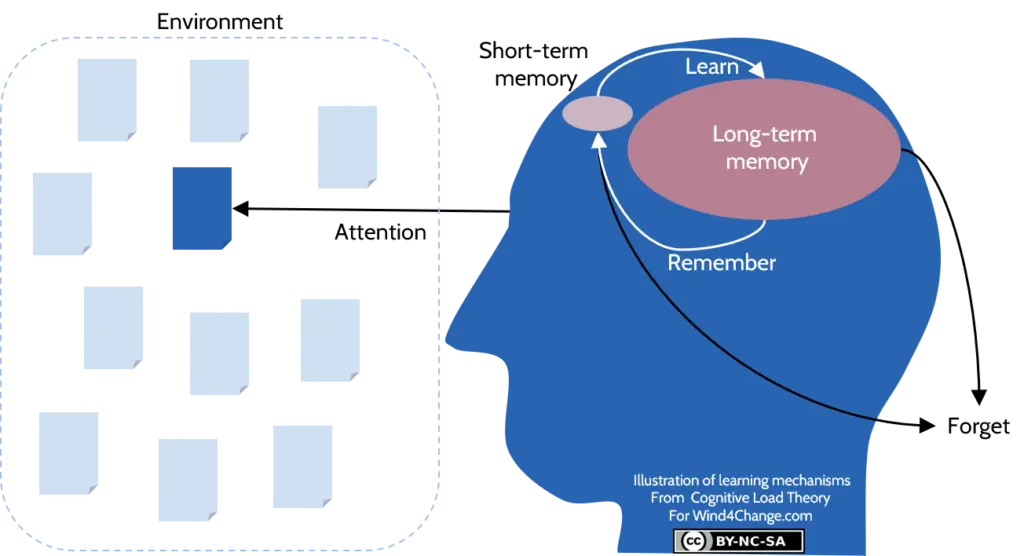
Research by Nelson Cowan, meanwhile, puts the storage limit at around 3 to 5 meaningful items, where an "item" can be a cluster of information that has already merged into one unit.
Does that limit apply equally to every employee? Not entirely, it turns out. Sweller explains that material that has been thoroughly learned gets stored in long-term memory as a schema, a knowledge pattern that lets many elements be treated as a single element. Once that schema is pulled back into working memory, the material is no longer bound by the same capacity and duration limits.
A senior employee who already holds the schema for a given procedure can follow dense explanations that would overwhelm a new hire. For instance, a video on incident-reporting procedure might introduce 5 new terms within a single minute. A new employee has to work hard just to grasp what each term means, while a senior employee can make the cognitive connections almost instantly.
When Visual Support Becomes a Burden
The consequence of this gap in schemas is known as the Expertise Reversal Effect, formulated by John Sweller, Paul Ayres, Slava Kalyuga, and Paul Chandler in 2003. Its core finding: instructional techniques that help novice learners can lose their benefit, or even backfire, as learners grow more experienced.
That's because novices, who don't yet have a schema, need guidance to anchor their understanding. For experts, that same guidance becomes excessive, and they end up having to reconcile it with knowledge they already hold. That reconciliation process eats into working memory capacity that could otherwise go toward learning, turning into irrelevant cognitive load, or extraneous cognitive load.
Based on research by Kalyuga, Chandler, and Sweller on the expertise reversal effect, text explanations integrated directly into a circuit diagram aid learning by reducing split attention. Split attention refers to the need to divide attention between a diagram and separate text.
After intensive training, though, a diagram without text actually produces better learning outcomes, because the text has by then become redundant. A similar pattern shows up with fully worked examples that include every step, which help novices but lose, or even reverse, that advantage as experience grows.
This finding complements the redundancy principle in multimedia learning. Richard E. Mayer and Roxana Moreno showed that animation with narration produces better understanding than animation with narration plus identical on-screen text, because the extra text overloads the visual channel. Expertise reversal adds one more layer: additional explanation that's useful for a novice can also become redundant for an employee who has already mastered the material.
It's worth noting this effect isn't universal. Many of the results in Kalyuga's review show only a partial reversal, and most of the underlying studies compare different groups at a single point in time rather than tracking the same individuals from novice to expert. Expertise is also task-specific, so an employee can be an expert at one procedure while still a novice at another. Because of that, "new employee" and "senior employee" are best treated as a starting point for analysis, not a fixed label.
Applying It at the Concept and Storyboarding Stage
The first step is getting to know the audience. The L&D team, together with the Subject Matter Expert (SME), can answer three questions right from the start: who's going to watch, what do they already know, and what decision should they be able to make after watching. Kalyuga notes that prior knowledge can be measured with a short diagnostic test.
Tenure alone doesn't necessarily reflect mastery of a procedure, so a few screening questions or results from a prior assessment tend to be more reliable.
The second step is giving novices a foundation without forcing it on everyone. The pre-training principle formulated by Richard E. Mayer is based on the finding that learners learn more efficiently once they already know the basics, such as key definitions and terminology.
For example, a safety-procedure video could open with a short section introducing terms and components, one that experienced employees are free to skip. This intro section should be brief and focused only on terms that will actually come up later in the main video. That way, novices get an initial schema to work from, while senior employees don't burn working memory on explanations they've already mastered.
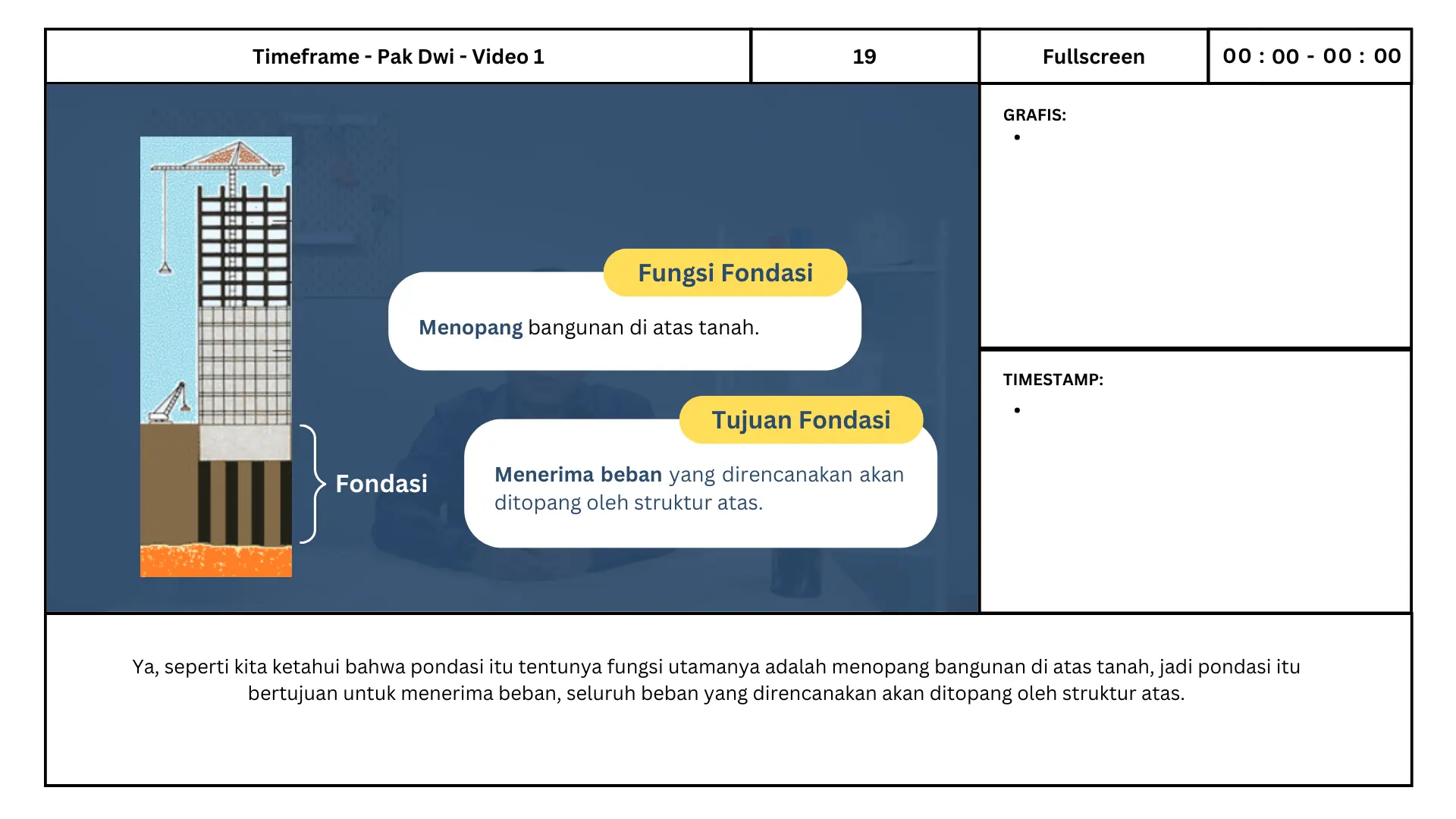
The third step is designing layers of support directly into the storyboard. Storyboard artists and designers can flag elements that serve as guidance for novices, such as extra labels on a diagram, step summaries, or supporting illustrations. Those elements can then be made optional, for instance through a separate chapter or a button in an interactive video. Kalyuga suggests scaling back that guidance gradually as proficiency grows, so that within a training series, the more advanced videos should carry leaner explanations than the introductory ones.
This approach still needs to be tested at each company. Running it past a handful of employees can reveal whether the intro section feels genuinely useful or just drags on, and whether the extra labels help or get in the way. Those test results then become the basis for revisions before the video goes into wider use.
Designing solid pre-production takes close collaboration between instructional design expertise and structured creative execution. Having handled more than 1,000 learning multimedia projects, Monkey Melody understands that every company has its own unique material, work culture, and competency targets.
We help L&D and HR teams design learning videos end to end — from breaking down material with an SME, to writing a cognitively-friendly script, building a storyboard, and executing production to a high standard.
Ready to turn your company's training materials into an impactful, efficient visual learning experience? Contact the Monkey Melody team via WhatsApp at +62 812-1954-8155 or email info@monkeymelody.com to discuss your project's needs.
More insights

Overcoming Cognitive Overload with the Right Mix of Audio and Visuals
Amid the rising trend of video learning for employee training, many companies focus too heavily on aesthetics and cram in too much content. The result: we often see videos…

Remember: Your Brain's Working Memory Has Limits
Companies often assume that a failed training program comes down to low employee motivation or dull foundational material. As a result, the fix usually…

Why You Should Avoid Overcrowded Learning Videos
Ever watched a learning video so packed with animation that it left you confused instead of informed? Often, in trying to avoid feeling stiff or boring, production teams end up adding…
Want the short version, applied to your company?
Let's talk about what this means for you.
Get in touch