

How Do You Keep Learners' Brains From Burning Out While Watching Learning Video?
Have you ever sat in front of a screen watching a training video packed with scrolling on-screen text, while the audio narration covers the exact same thing, word for word?

Two Pathways in the Brain
Have you ever sat in front of a screen watching a training video packed with scrolling on-screen text, while the audio narration covers the exact same thing, word for word?
Most people end up drowsy. That's because in a situation like that, without us even realizing it, the brain is working twice as hard as it needs to. In the end, far less information actually gets through than we'd hope.
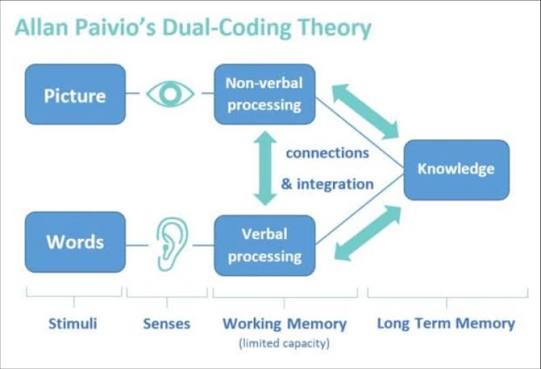
In the late 1960s, psychologist Allan Paivio of the University of Western Ontario put forward a theory that went on to reshape how we understand learning. It became known as Dual Coding Theory. It turns out the human brain processes information through two separate, independent channels. The first is the verbal channel, which handles all language-based information. The second is the non-verbal channel, which processes visual information such as images, diagrams, animation, and the like.
When someone takes in information through both channels at once, the brain builds two interconnected memory traces. Two connected representations are far stronger than a single one on its own. As a result, absorbing and retaining information over the long term becomes far more effective.
Paivio himself referred to the basic units of these two systems as logogens for verbal representations and imagens for non-verbal ones. Each can be activated on its own, but when both are activated together and cross-reference each other, that's what Paivio called dual coding.
A meta-analysis by Butcher (2006) found that pairing text with a relevant diagram improved comprehension by 0.48 standard deviations compared with text alone. That might sound small, but it's actually a substantial effect.
Why Visual-Verbal Design Matters So Much
Understanding Dual Coding Theory alone isn't enough without grasping one more key idea: each channel has a limited capacity. We have what's called working memory, the brain's workspace where new information is processed before it moves into long-term memory. And working memory has its limits.
Psychologist George Miller showed as far back as 1956 that the average person can hold only around seven chunks of information in working memory at any one time.
This is exactly where learning-content design becomes critical. When a learning video displays lengthy on-screen text while simultaneously delivering audio narration covering the same material, the verbal channel becomes overloaded. Both compete for the same limited capacity. Rather than expanding how much information gets absorbed, a design like this instead creates what John Sweller, in his Cognitive Load Theory, calls extraneous cognitive load—unnecessary cognitive burden.
Richard Mayer, who built his Cognitive Theory of Multimedia Learning (CTML) on the foundation of Paivio's Dual Coding Theory, demonstrated this through more than 200 experiments over three decades. One of his most striking findings: participants who watched an animation about how lightning forms while listening to audio narration produced roughly 50% more correct solutions on a problem-solving test than participants who watched the same animation paired with on-screen text.
This principle, which Mayer calls the Modality Principle, explains why so many corporate learning videos fail to land. The usual culprit is a visual design packed with too much text, running alongside narrated audio at the same time. That combination drains participants' mental capacity before they even get to process the core message.
Research from PopVideo found that employees are 95% more likely to retain knowledge delivered through video compared with text alone. Mayer himself showed that multimedia instruction following dual-coding principles improves transfer-test performance by as much as 89% compared with text alone.
The challenge for many companies lies in getting L&D teams to understand that strong visual aesthetics and cognitive effectiveness are two different things. A video can look polished and professional, yet still fail to help participants learn if its elements don't work together in support of each other.
Having worked on more than 1,000 learning multimedia projects, Monkey Melody understands that every company faces different challenges and has different goals. That's why we offer a tailored approach to ensure every video we produce achieves its intended training objective. By combining the latest technology with a creative approach, we're ready to help your company meet the training challenges of the future.
More insights
Research on Interactive Video Among Biology Students
The use of video as a self-paced e-learning medium has become standard practice in corporate training programs and higher education.
The Science Behind Why Microlearning Works
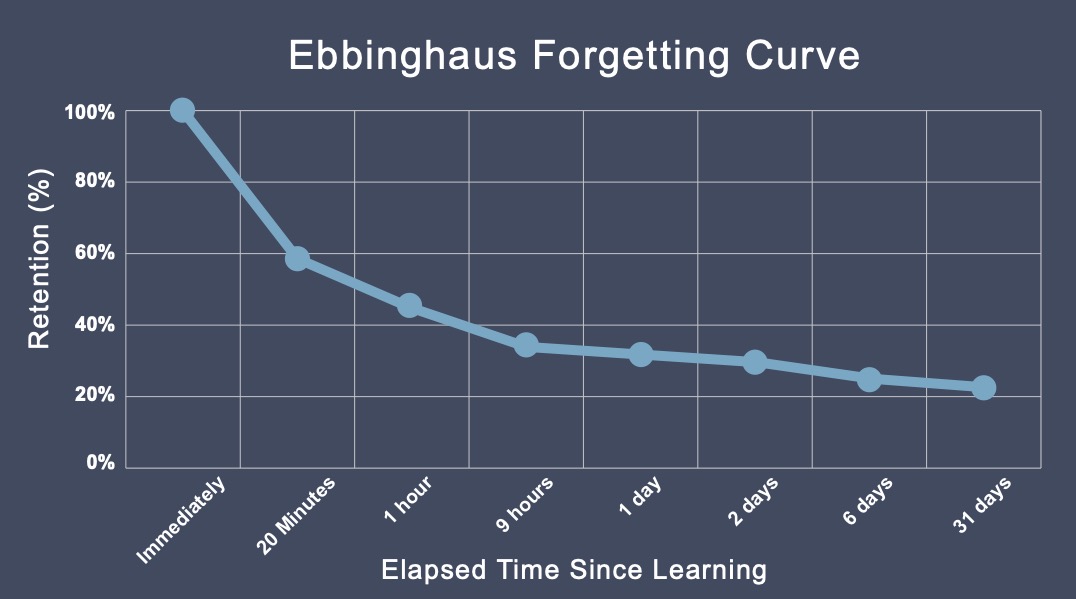
A single long training day often fails because it fights how the brain actually works — see how microlearning, the Forgetting Curve, and spaced repetition make material actually stick.
How AI Video Search Is Transforming Corporate L&D
Thousands of hours of training video pile up in your company's LMS, hard to search once a program ends — see how AI Video Search is changing the way L&D teams find specific moments buried in that dark data.
Want the short version, applied to your company?
Let's talk about what this means for you.
Get in touch