

The Rise of the Accidental Instructional Designer
Large companies usually have a dedicated team or instructor whose job is to put together employee learning material. But for smaller companies, having dedicated staff…

Employees Suddenly Saddled with Building Learning Modules
Large companies usually have a dedicated team or instructor whose job is to put together employee learning material. But for smaller companies, having dedicated staff for this function is often not a priority. As a result, frontline employees end up reluctantly taking on the role of both instructor and content creator. Picture an operations manager who's normally skilled at putting together financial reports suddenly being asked to build an e-learning module for a training need.
In Indonesia's corporate world, this phenomenon is extremely common. We often call these people Accidental Instructional Designers — "Desainer Pembelajaran Dadakan."
Becoming an instructional designer by accident turns out to be a fairly widespread phenomenon. Industry research shows that more than 85% of practitioners who design training in companies actually have no formal educational background in instructional technology or curriculum design. They are Subject Matter Experts (SMEs) or internal staff chosen simply because they're considered the most knowledgeable about the operational material.
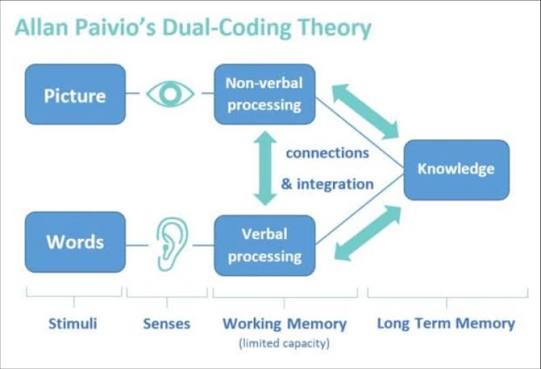
Let's examine this phenomenon through the lens of the Cognitive Theory of Multimedia Learning. The human brain, particularly its working memory capacity, has very limited space for processing and absorbing new information at any one time. When employees are confronted with walls of long text with no clear visual hierarchy, they immediately experience cognitive overload.
Learners' brains burn through their energy just trying to sort out which information is essential to apply at work and which is merely background filler. In the end, motivation to learn drops sharply. Participants go through the training module simply to tick an administrative box, with limited actual understanding.
Equipping Them with Four Learning Elements
To prevent cases like this from repeating, HR teams and Corporate Training leads play an enormous supporting role. The first step is to shift their fundamental mindset. Help them understand what an instructional designer actually needs to know.
Introduce your team to the concept of ideal design balance, which should take into account at least these four key elements:
1. The Andragogy Approach (How Adults Learn)
Adults don't learn by memorizing theory the way schoolchildren prepare for a national exam. Working professionals are problem-centered learners. Before writing a single slide or line of script, ask the content creator to answer one fundamental question: "What operational problem will actually get solved on the ground once employees master this material?" Every element inside the module should be focused on answering that question.
2. Curating Content Substance
As an expert in their field, a person tends to feel that every single piece of information is valuable. Your job is to help them sort information into three priority tiers:
- Must Know: the core material employees absolutely need to master so their main job gets done without error. This is the part that must go into the interactive multimedia module.
- Should Know: background or context around the work process.
- Nice to Know: company history or supplementary theory. The second and third categories should be split off into a downloadable reading appendix, rather than crammed into the main module screen to be memorized.
3. Visual Execution and Cognitive Navigation
Visual design in e-learning is never about making things look pretty or colorful for its own sake — it's about directing where the learner's eyes focus. Using white space, contrasting color to highlight keywords, and carefully calibrated illustration all go a long way toward lightening learners' mental load.
For example, instead of writing five long paragraphs about printing-press safety procedures, a simple animated diagram that visually highlights the danger zone will be far more effective at instilling awareness.
4. Using Technology Purposefully
The modern learning platform or LMS a company has purchased usually comes packed with interactive features that often go unused. Encourage your internal team to explore scenario-based learning methods. For example, when designing a module on handling customer complaints, don't just list phrases that are and aren't allowed. Build a branching story where employees have to choose a response from several options when facing an angry customer, then show them directly, on screen, the good or bad consequences of their choice.
After producing more than 1,000 learning multimedia projects, Monkey Melody understands that every company faces different challenges and goals. That's why we offer a tailored approach to ensure every video we create achieves the intended training objectives. Using the latest technology and a creative approach, we're ready to help your company tackle the training challenges of the future.
More insights
Research on Interactive Video Among Biology Students
The use of video as a self-paced e-learning medium has become standard practice in corporate training programs and higher education.
The Science Behind Why Microlearning Works
A single long training day often fails because it fights how the brain actually works — see how microlearning, the Forgetting Curve, and spaced repetition make material actually stick.
How AI Video Search Is Transforming Corporate L&D
Thousands of hours of training video pile up in your company's LMS, hard to search once a program ends — see how AI Video Search is changing the way L&D teams find specific moments buried in that dark data.
Want the short version, applied to your company?
Let's talk about what this means for you.
Get in touch