

Effective Learning Videos Need to Follow These Principles
Allan Paivio, a cognitive psychologist at the University of Western Ontario, spent nearly four decades studying how humans process and store information. His theory…

The Theory Behind How the Brain Processes Information
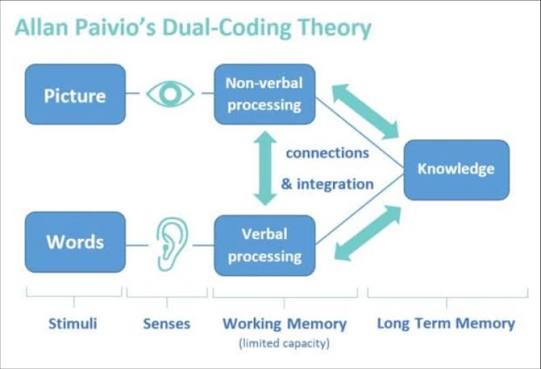
Allan Paivio, a cognitive psychologist at the University of Western Ontario, spent nearly four decades studying how humans process and store information. His theory, first published in 1971 and expanded in 1986, revealed that the human brain has two separate but interconnected processing systems: a verbal system that handles language, and a non-verbal system that handles imagery.
Paivio found that images are easier to remember than words because images trigger dual encoding—both a verbal label and a visual code—whereas words rarely activate the non-verbal system. John Medina, in his book Brain Rules, found something similar. His research showed that after three days, people retain only about 10% of information presented as text alone, but that figure jumps to 65% when the verbal information is paired with a relevant image.
Also tied to how the brain processes information, John Sweller developed Cognitive Load Theory in 1988, showing that human working memory is extremely limited, both in capacity and duration.
Sweller identified three types of cognitive load that compete for this limited capacity. First, there's intrinsic load, the inherent complexity of the material itself. For example, learning a university-level math concept produces higher intrinsic load than learning middle-school-level math, because there are many interrelated elements that have to be processed simultaneously.
Second, there's extraneous load, which arises from poor instructional design. For example, adding a decorative graphic that looks appealing but isn't relevant to the material. This consumes processing capacity in the brain without delivering any learning benefit.
Third, there's generative load, the productive mental effort used to build knowledge schemas and integrate new information with existing knowledge.
Designing Video That Reduces Cognitive Load
These three types of load are additive. When intrinsic load plus extraneous load plus generative load exceeds the limited capacity of working memory, learning fails. This is exactly where learning video design becomes so important. A well-designed video can reduce extraneous load, freeing up more brain capacity for generative load—the actual learning itself.
Richard E. Mayer, drawing on more than 200 experimental studies, translated dual-coding theory and cognitive load theory into concrete multimedia design principles.
The segmenting principle, for instance, holds that breaking complex content into shorter pieces works better. It manages intrinsic load by not forcing the brain to process too much at once. The modality principle shows that narration plus graphics beats text plus graphics for most learners, because it makes optimal use of dual coding.
Yet in practice, corporate training videos often violate these principles. Picture a training video trying to teach financial report analysis. When that video includes flashy but irrelevant animation, excessive background music, plus full on-screen text that's identical to the narration, every one of those elements adds extraneous load. It's no wonder learners struggle to remember the material—their brain capacity gets used up processing unimportant elements instead of understanding how to actually analyze a financial report.
After producing more than 1,000 learning multimedia pieces, Monkey Melody understands that every company faces different challenges and goals. That's why we offer a tailored approach to ensure every video we create achieves the intended training objective. Using the latest technology and a creative approach, we're ready to help your company tackle the training challenges of the future.
More insights
Research on Interactive Video Among Biology Students
The use of video as a self-paced e-learning medium has become standard practice in corporate training programs and higher education.
The Science Behind Why Microlearning Works
A single long training day often fails because it fights how the brain actually works — see how microlearning, the Forgetting Curve, and spaced repetition make material actually stick.

How AI Video Search Is Transforming Corporate L&D
Thousands of hours of training video pile up in your company's LMS, hard to search once a program ends — see how AI Video Search is changing the way L&D teams find specific moments buried in that dark data.
Want the short version, applied to your company?
Let's talk about what this means for you.
Get in touch